
In 2025, a project to set up a farm to support students in precarious circumstances was launched.
In Mbarara, two priests from the Chemin Neuf community, Fathers Arnaud Goma-Okadina and Albert Zongo, began tilling the land with nothing but a hoe. It was a project that brought together students and people of goodwill. Father Zongo shares the story of how it all began.
The origins of the agro-pastoral project
When the community asked me to come to Uganda, I was on a retreat at Hautecombe Abbey (Savoie). Even though I was preparing for an exam for England at the time, I simply said “ yes ” to this mission, recognising it as the Lord’s will for me.
Two weeks afterwards, when I met my new supervisor, he explained the mission to me in person and added that we had a bit of space available, notably for a banana plantation. Bananas, known locally as Matoké, form the staple of the Ugandan diet.
On my arrival, I was struck by the number of young students who came to ask us for financial help – whether for medical treatment, school fees or even a meal. As a religious, I really had nothing to offer them. And this weighed heavily on my heart in prayer. One day, whilst praying in front of this arable land, I felt a sense of certainty that this plot was my ‘five loaves and two fish’ and that I could offer it to help the students. How? I had no idea.
So the Matoké field project took on a new dimension in my mind: an agro-pastoral project. I had no doubt that the Lord, who had inspired me with this, would know how to guide things. I then spoke to my superiors, both of whom encouraged me to launch this agro-pastoral project.
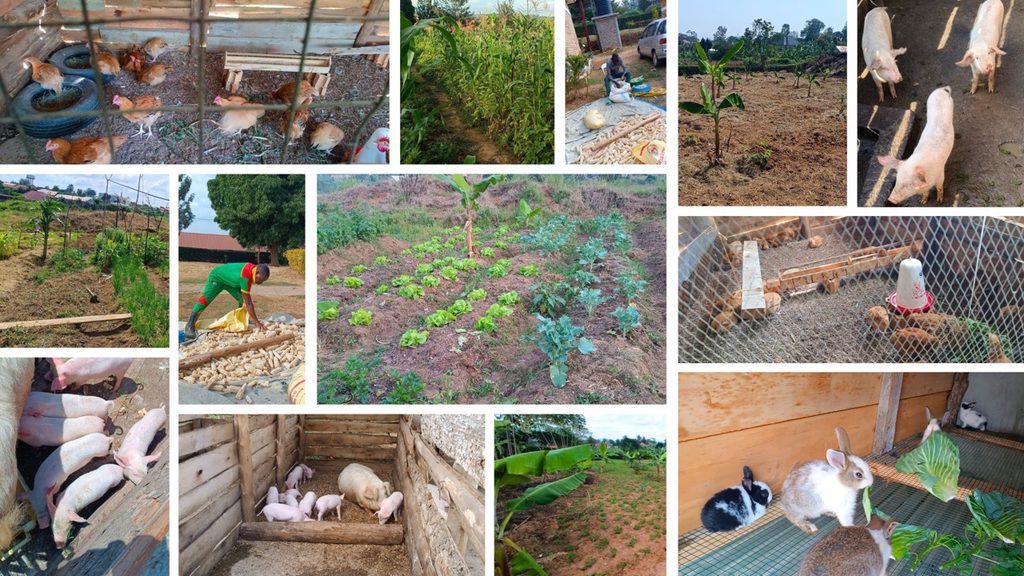
Initially, it was an agricultural project, comprising in particular a field of matoké and sweet bananas, as well as beans, potatoes, sweet potatoes, maize, groundnuts, cassava, a vegetable patch and a good number of fruit trees in full growth. Here, the work is still very traditional and is done by hand with a hoe. It’s tough on the back, but that’s our reality for the time being.
Confirmation of the project
As I was waiting for Father Arnaud Goma-Okadina, who was due to join me later, I told him about this project. He welcomed the idea, saying that he had previously received training in agro-pastoralism. For me, this confirmed that this project was from the Lord.
On his arrival, he saw for himself what had been done on site. He then contacted some of his friends, who promised to provide financial support for the project. The funds received enabled us to build a poultry house capable of holding between 300 and 500 birds, a pigsty with three pens – which we have since expanded to six – and rabbit hutches.
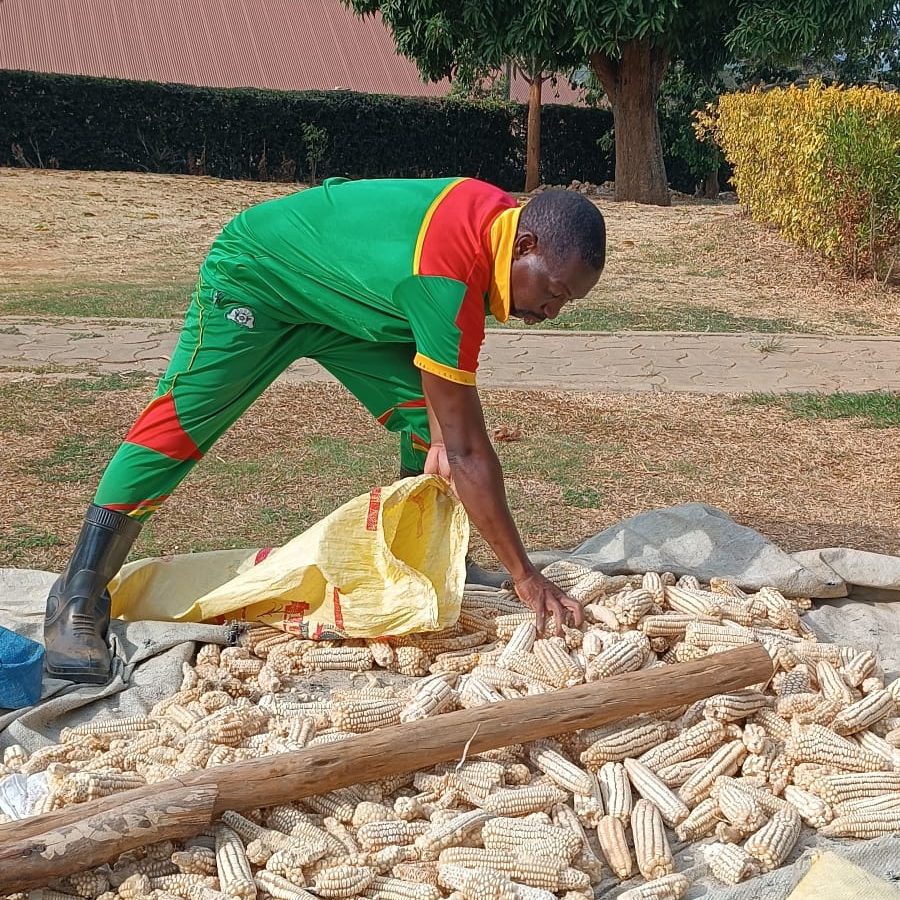
By the grace of God, the project is already up and running, and we intend to expand it in future as our resources allow. The harvests have yielded nearly 70 kg of beans, 4 x 50 kg sacks of groundnuts, 2 x 50 kg sacks of maize, etc., whilst the banana plantation is beginning to bear its first fruit.
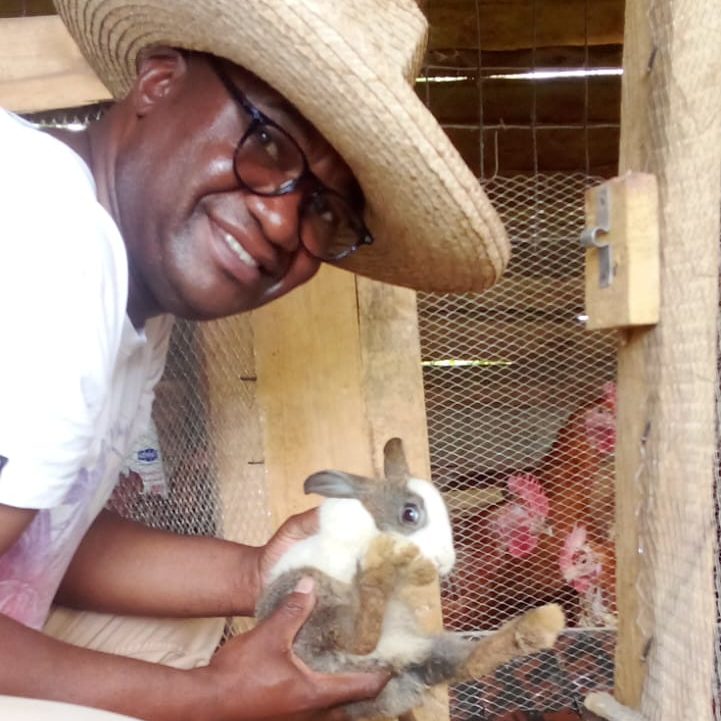
As for livestock, we have around 230 laying hens after suffering some losses due to disease, and a few broiler chickens. Starting with four pigs (two piglets and two adults), the sow gave birth to 13 piglets at the end of August, eight of which are currently surviving and growing well. As for the small mammals, mortality strikes very often and mercilessly; we currently estimate a population of around twenty rabbits, including a number of pregnant does.
For the time being, we are particularly feeling the strain of the costs, as looking after all these animals is very expensive (around 400–500 euros per month). However, we are hopeful that the future will prove us right in having launched these projects, as we remain focused on our objective of reducing the country’s financial expenditure in the medium and long term.
A project currently under development
In this first year, all of this has been carried out by ourselves and three young people on a missionary year who have been gaining experience with the local community. We also have the help of one member of staff.
Some students also lend us a hand, in return for a payment that goes a long way towards helping them with their studies. And many of them are very committed.
Despite this, the workload takes its toll, especially as we have to balance it with our pastoral duties and our religious life, which remain our priority.
‘Unless the Lord builds the house, the builders labour in vain’
Ps 126:verse 1
Our involvement in this project serves as a testimony and a learning experience for many, in a country where priests tend to spend more time in an office than on farmland. Some mechanical equipment, such as a small hand-operated tractor, would make our work more efficient, but we are proceeding gradually with the resources at our disposal.
We entrust all these projects, which we describe as ‘small beginnings’, to your prayers, so that the Lord may bless them. For ‘Unless the Lord builds the house, the builders labour in vain’ (Ps 126:1). In this beautiful East African country, Uganda, the witness we wish to offer today is to be able to put into practice ‘Ora et Labora’ (Prayer and Work) according to the Benedictine Rule, as we already do in some of our community houses.
‘Alone we go fast; together we go further’. With your support and your prayers, we shall go far in serving this country and the young people entrusted to our care here.
P. Albert ZONGO, Ccn Ouganda
Community missions in Uganda
The Chemin Neuf community was founded in Uganda, in the Diocese of Mbarara, eight years ago, to support the CANAmission, which has been active in the country since 1995.
In 2018, two priests from the community were sent in response to an invitation from the archdiocese to establish the spirituality of Chemin Neuf and to put its charism of accompaniment and formation at the service not only of CANA couples, but also of young people. They were entrusted with the care of St Joseph’s University Parish.
Last year, two further missionary priests from the Community took over from the first group to arrive. Like them, this pair of priests continues to carry out the missions on the ground. Alongside them are around fifteen Ugandan married couples, members of the Chemin Neuf Community, who are also involved in the missions and community life.
Having observed real poverty in the country, and the great vulnerability of pupils—particularly girls—the community has launched a project to build a house for students. This project is progressing slowly due to limited financial resources, but we believe that, with everyone’s support, it will soon come to fruition through the grace of the Lord.